


Quick Takeaway: Those eerie 3-second silent calls from unfamiliar numbers aren’t bad mobile reception or accidental pocket dials. They are automated “ping” dialers running Answering Machine Detection (AMD). The moment you say “Hello?”, software flags your number as a live, responsive human—multiplying its value on underground scam lists.
It is 3:14 PM on an ordinary Tuesday. Your phone buzzes on the table with an unfamiliar 10-digit number.
Maybe it is an Amazon or food-delivery rider stuck at the gate. Maybe it is your bank, a clinic, or a job recruiter. So you swipe green and press the phone to your ear.
“Hello?”
Nothing. Just hollow, eerie static.
“Hello?? Anyone there?”
A faint digital click. Call ended. Total duration: 00:03.
Most of us shrug, blame spotty mobile reception, and toss the phone back on the couch. Nobody spoke, nobody asked for an OTP, and nobody pitched a shady loan—so nothing happened, right?
Wrong. Everything the caller wanted already happened inside those three quiet seconds. And that single polite “Hello?” just made your phone number roughly 15 times more valuable on the underground scam market.
Nobody Butt-Dialed You. You Were Just “Pinged.”
Modern scam syndicates don’t sit around dialing random digits by hand like 1990s telemarketers. Instead, they buy giant spreadsheets of leaked phone numbers—often 5 million to 10 million rows at a time—scraped from old shopping apps, contest giveaways, and data breaches.
There is just one expensive problem for scammers: most leaked phone lists are full of dead weight.
Roughly half of any leaked dump consists of disconnected SIMs, switched-off backup phones, office landlines, or cautious people who never answer unknown callers. If a scam call center paid human operators to dial millions of dead numbers one by one, they would burn through their payroll before lunch.
So before a human scammer ever wastes breath on you, a machine goes first. Nearly every 3-second silent call comes from one of two automated engines:
- Recon “Ping” Bots: Pure scouting software that fires thousands of cheap internet (VoIP) calls per minute with zero humans attached. Its only mission is to test which numbers ring, get picked up, and produce a real human voice.
- Predictive Auto-Dialers: Inside an active 40-seat scam call center, a computer dials 200 numbers at the exact same second, betting that ~160 people won’t pick up. When 45 people happen to answer at once, the extra 5 callers get “abandoned” to 3 seconds of silence because every headset operator is already busy talking to another target.
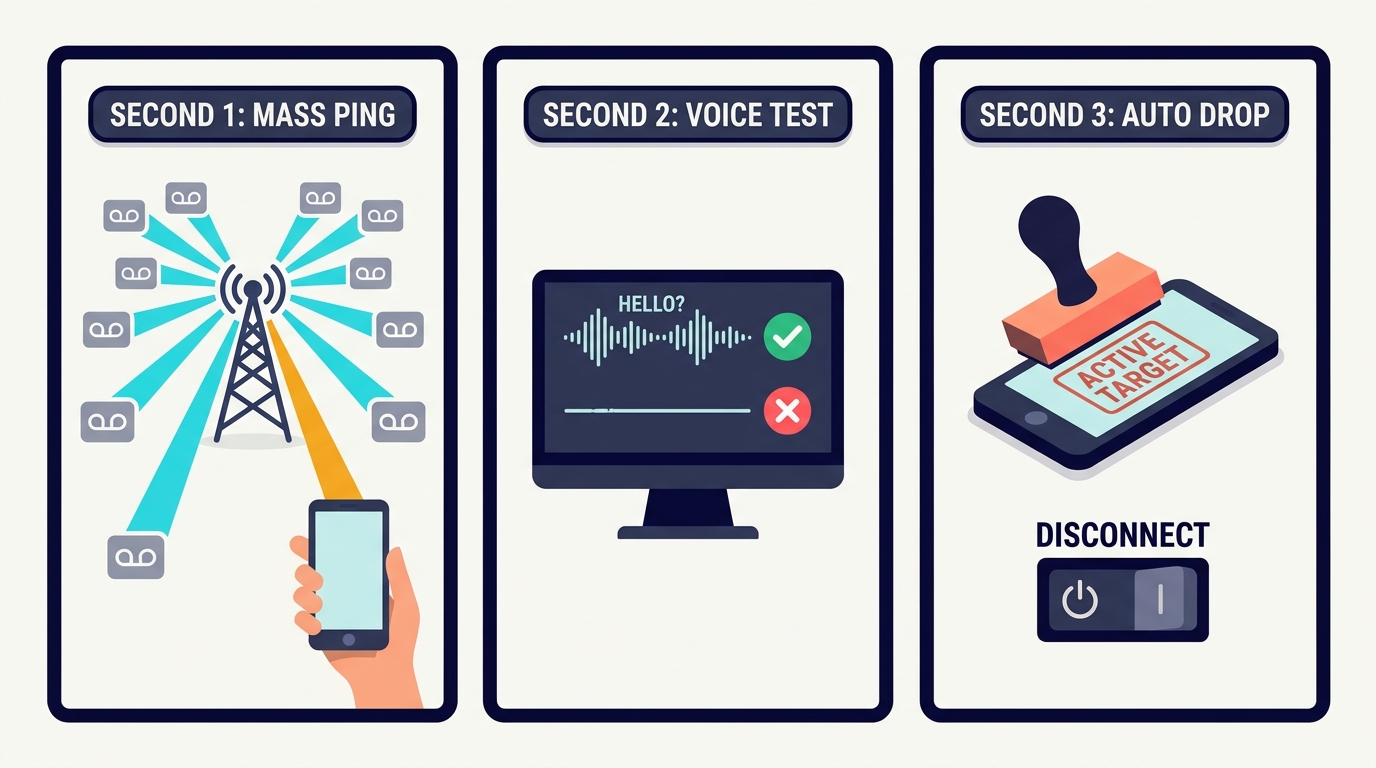
Second-by-Second: What Happens Inside 00:03
Why doesn’t an automated scam call play a message or connect a human the instant you swipe green? Because the software needs roughly 2,000 milliseconds to run a filter called AMD (Answering Machine Detection).
Here is the acoustic trick the machine uses to tell you apart from a carrier voicemail box:
- How a voicemail robot sounds: When a call hits voicemail or an out-of-coverage message, it speaks in a long, continuous 5-to-8-second stream (“The number you have dialed is currently unavailable, please leave your message after the tone…”).
- How a real human sounds: A human says one short burst—“Hello?” (~0.5 seconds)—followed immediately by 1.5 seconds of expectant silence waiting for the caller to reply.
That tiny burst-then-pause waveform is a dead giveaway. Within two seconds of your “Hello?”, the software quietly updates the dossier attached to your digits:
Target Verified: Active SIM · Real Human · Picks Up Unknown Numbers · Awake During Work Hours
If a pure Recon Ping Bot called you, its job is complete—click, it hangs up at 00:03. And if it was a live call-center dialer with an open operator desk, you’ll hear that telltale micro-beep or sudden background office chatter right before a voice jumps in: “Hello sir, calling from FedEx Customs Department…”
How One “Hello?” Multiplies Your Black-Market Price Tag
Have you ever noticed how you can enjoy weeks of peace, answer one mysterious empty call on Monday, and suddenly get bombarded by five fake bank KYC texts, loan pitches, and parcel-seizure calls by Wednesday?
That isn’t coincidence. Your phone number just got promoted up the underground lead ladder.
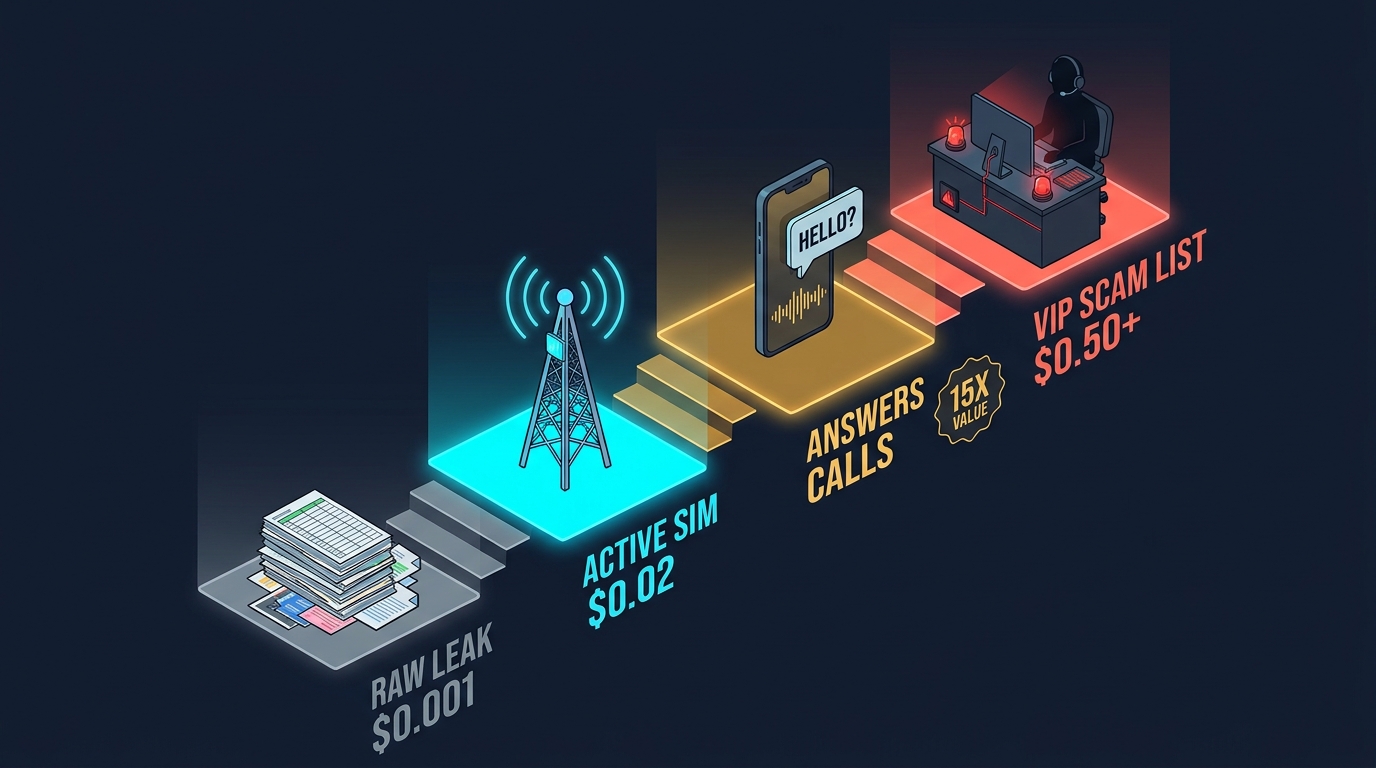
| Lead Tier | What the Broker Knows | Typical Underground Price | Who Buys It |
|---|---|---|---|
| 1. Raw Leaked Dump | Unsorted digits from old app breaches; half dead | ~$0.001 (₹0.08) / number | Bulk ping-bot operators |
| 2. Carrier-Active SIM | Number exists on a mobile network and rings | ~$0.02 (₹1.50) / number | Mass SMS & WhatsApp blasters |
| 3. Verified “Hello” Responder | Confirmed human who answers unknown numbers | $0.30+ (₹25+) / number | Organized scam call centers |
| 4. Enriched VIP Target | Matched with leaked name, city, or shopping history | $0.50–$2.00+ / number | “Digital Arrest”, courier & bank impersonators |
By speaking first, you did the filtering work for them. You proved there is an attentive, polite human at the end of those 10 digits.
Fact Check: Can Scammers Clone Your Voice in 3 Seconds?
If you are in any family WhatsApp group, you have probably seen dramatic forwarded warnings claiming: “NEVER say ‘Yes’ or ‘Hello’—AI hackers record 2 seconds of your voice to authorize bank loans!”
Let’s separate viral urban legends from real telecom threats:
- Myth — Saying “Yes” authorizes a bank transfer: False. No legitimate bank wires out your savings because someone plays back a scratchy audio clip of the word “Yes.”
- Half-Truth — 3-second AI voice cloning: Modern AI voice-cloning tools still need roughly 15 to 30 seconds of clear, expressive sentences to impersonate you convincingly—not a muffled half-second “Hello?” over cell static. Scammers only harvest voice samples if they keep you chatting longer.
- 100% Real Danger — The 1-Ring Overseas Trap (Wangiri): If a strange international prefix (
+216,+375,+247,+92) rings once and cuts off before you even touch the screen, never call it back. Wangiri is Japanese for “one ring and cut”—calling back routes you to an overseas premium-rate toll number that drains money per minute while playing fake hold music.
Bonus trap: Never press 1 or 9 when a robocall says “Press 9 to be removed from our calling list.” Illegal dialers don’t keep honour-system opt-out lists—pressing a key just proves an obedient human is holding an unlocked phone.
How to Outsmart the Machine: The “2-Second Silent Rule”
You can’t realistically ignore every unfamiliar number forever—sometimes you genuinely are waiting for an electrician, a parcel, or a hospital callback. Fortunately, defeating an Answering Machine Detection bot takes zero paid apps and just two seconds:
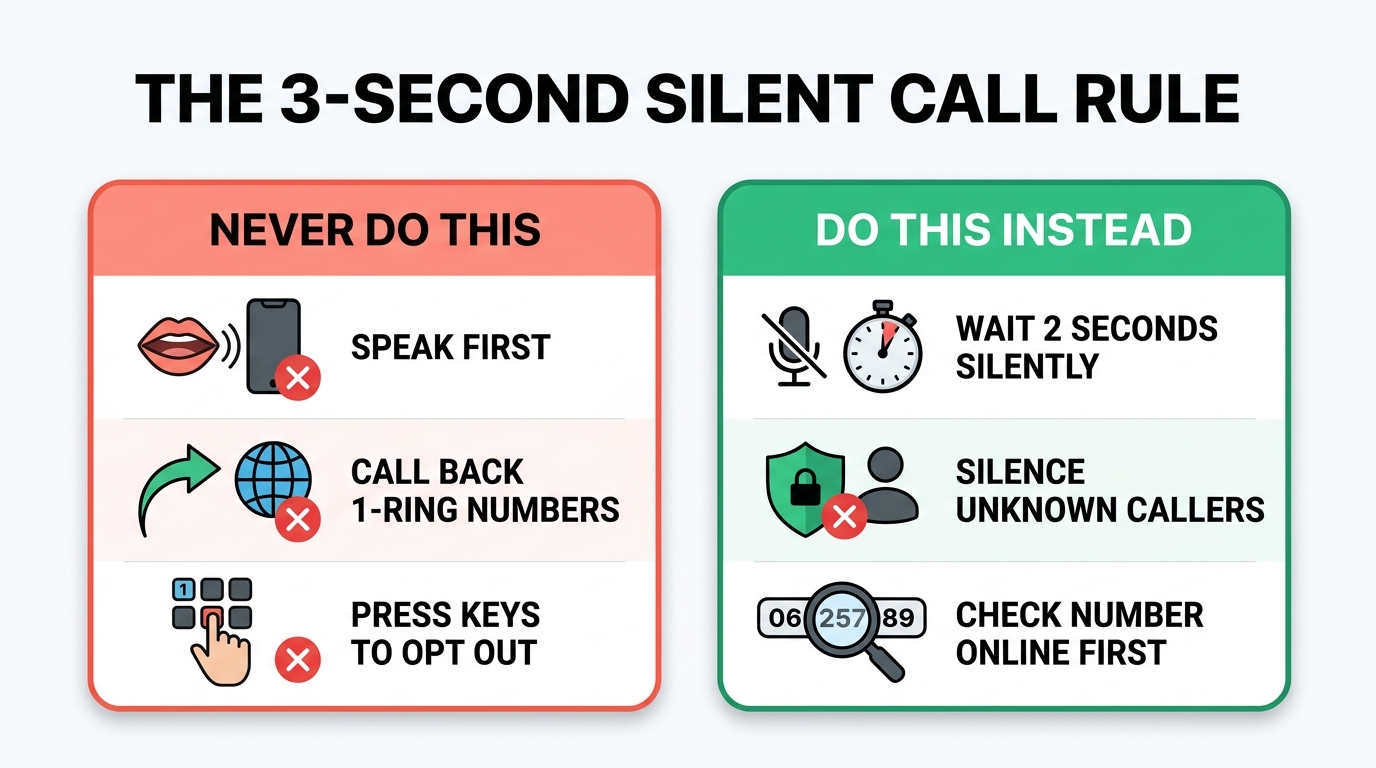
- Use the 2-Second Silent Answer: When you must pick up an unknown call, swipe green and stay completely silent for two full seconds (or tap Mute immediately).
- If it is a real person (a delivery rider, clinic, or colleague), they will hear the call connect and speak first: “Hello? Sir, I’m outside the gate.” Unmute and talk normally!
- If it is a Ping Bot or Auto-Dialer, its microphone hears zero human burst—just dead air. Its algorithm assumes the line is dead, broken, or a fax modem, marks your number unresponsive, and hangs up on itself.
- Turn On Built-In Unknown Caller Filtering: Both iPhone (Settings → Apps → Phone → Silence Unknown Callers) and Android (Phone app → Settings → Caller ID & spam) can screen first-time callers automatically.
- Investigate Mystery Numbers Quietly Instead of Calling Back: If an unknown number called twice and left you curious, don’t dial it back and alert a scammer’s switchboard. Paste the digits into a free Reverse Phone Lookup or Mobile Number Tracker first—you can check carrier network, region, and whether it’s a disposable VoIP line versus a real mobile SIM, completely invisibly.
Bottom line: Next time an unknown number calls and greets you with eerie silence, don’t fill the quiet with “Hello?” Let the robot stare into dead air—and watch your spam calls quietly dry up.